When Your ML Model Thinks the Office Is Haunted: How a “ghost problem” made DART even smarter
After training our DART (Distributed Acoustic Reasoner for TAK) model to detect gunfire with up to 95% accuracy, our team expected smooth sailing as we deployed the plugin in new environments.
Then we moved offices.
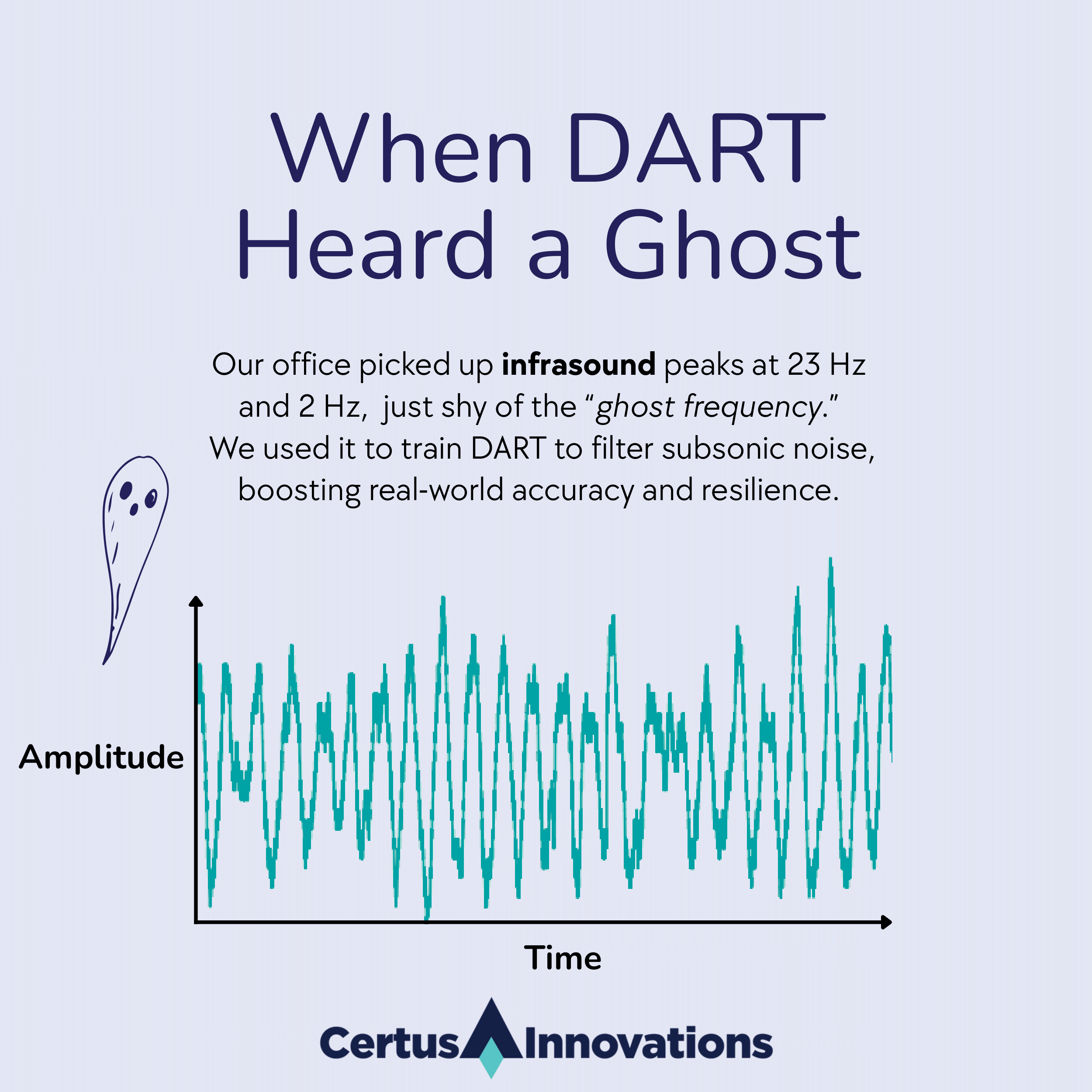
While testing DART at our new workspace, the system started lighting up with false detections. ATAK screens were flooded with gunshot alerts. Except… no one was firing a weapon. When we visualized the background signal, we saw something new: a dense series of peaks, invisible to the human ear but unmistakable to our sensors.
Is our new office haunted? We wondered to one another. Maybe it’s the seasonality of it all that lead us to momentarily presume ghosts. Fortunately we were able to discover the true culprit.
Infrasound – low-frequency vibrations often linked to heavy machinery, traffic, and yes, even “paranormal activity” for those who believe. The new workspace was radiating energy below 20 Hz, flooding our model with invisible noise. Instead of calling an exorcist, our team did what we do best: we engineered our way through it.
We quickly built a new audio augmentation pipeline to introduce multiple infrasound layers during model training, teaching DART to recognize and ignore the “ghost noise” that confused lesser systems. The result: stronger performance in real-world environments and higher resilience against unpredictable signal interference.
DART incorporates realistic data augmentations, such as background noise and microphone distortions through a hard negative-class dataset, including fireworks, doors slamming, chopping wood, etc., to prevent the model from training on just ‘loud’ or ‘sharp’.
That’s the kind of adaptability we pride ourselves on. Because for us, every anomaly is an opportunity: to refine, to improve, and to deliver technology that doesn’t just meet mission needs, but exceeds expectations.
When your ML starts hearing ghosts, you now know who to call.
Learn more about DART, TEAM-ML, and our broader machine learning initiatives at certusinnovations.com.