
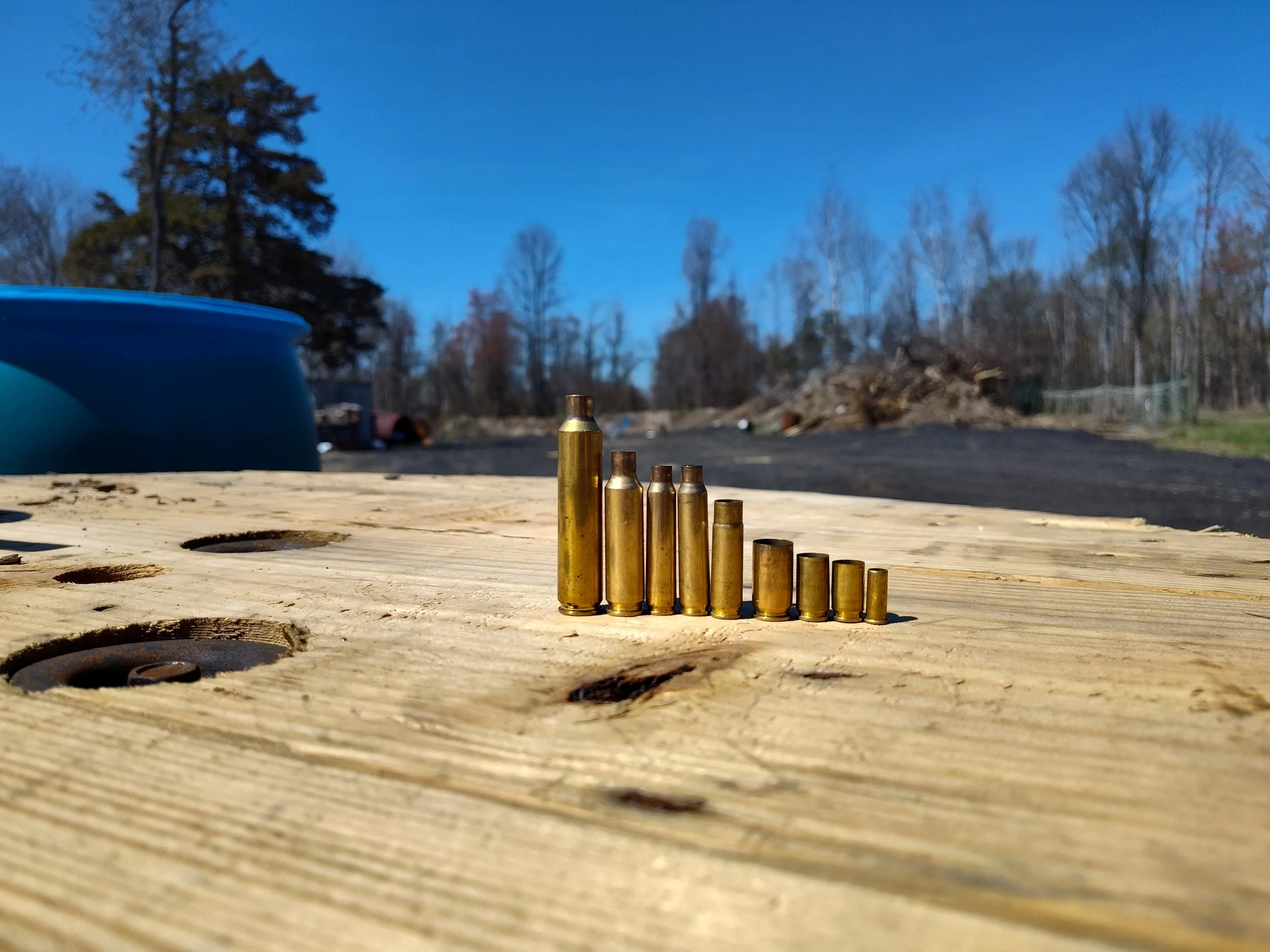
We tested gunshot detection in real-world conditions across 12 calibers, 22 platforms, and 27 cartridges. Two of those calibers, .28 Nosler and 6.5 Creedmoor, have never appeared in an open dataset before.
What we found exposes a fundamental gap between lab performance and reality.
The Problem: Background Noise Looks Identical to Gunshots in Standard Audio Analysis
We recorded a 9x19mm pistol and shot 124 gr cartridges at 0, 60, and 105 seconds.
When recording base audio, opening the audio file in a program like audacity will look something like this:

Note the amplitude spikes at 30 sec, 85 sec, and 160 sec. While those aren't gunshots, they may present themselves as such. This is mission-critical: field detection systems must distinguish signal from noise accurately. Whether they’re actual gunshots or just background noise, amplitude spikes can present similar to Machine Learning (ML) models trained only in laboratory conditions.
That's where spectrograms change everything.
The Solution Part 1: Mel-Scale Filtering Isolates Threats from Chaos
Displayed below is a mel-scale spectrograph of the identical 9x19mm pistol time-domain data from above:

The mel-scale, a perceptual frequency scaling system modeled on human hearing, effectively displays the gunshots much clearer than the time-domain data, distinctly separating actual shots (5, 60,105 seconds) from background noise (30, 85, and 160 seconds).
By emphasizing lower frequencies (where speech and environmental noise live) and compressing higher frequencies, this human-centric approach delivers measurable improvements over raw audio. However, field conditions revealed a critical limitation.
The Solution Part 2: Prioritize High Frequencies
While mel-scale filtering improved accuracy in controlled settings, real-world field testing exposed insufficient noise rejection. The mel-scale's emphasis on low frequencies inadvertently amplifies external noise sources like wind, speech, and livestock that dominate those bands. To achieve field-ready performance, we needed to flip the strategy entirely.
We revisited linear-scale spectrograms:
While mel-scaling emphasizes low-frequency features, linear-scale spectrograms highlight high-frequency characteristics. This simple shift enables far more precise gunshot isolation: most environmental noise concentrates at low frequencies; few sources produce sustained high-frequency noise; and almost nothing mimics the broadband signature of a gunshot.

While mel-scaling emphasizes low-frequency features, linear-scale spectrograms highlight high-frequency characteristics. This simple shift enables far more precise gunshot isolation: most environmental noise concentrates at low frequencies; few sources produce sustained high-frequency noise; and almost nothing mimics the broadband signature of a gunshot.

Comparing background noise signatures between mel-scale (above) and linear-scale (below) outputs reveals that gunshot frequencies remain crisp while nearly all ambient noise disappears.
Most existing gunshot detection datasets suffer from limited cartridge diversity and heavy reliance on lab conditions. Fewer still maintain identical firearms shooting multiple rounds under controlled field conditions. By testing across 12 calibers, 22 platforms, and 27 cartridges, including two never before captured in public datasets, Certus Innovations has built the real-world foundation that bridges the gap between what detection systems promise and what they actually deliver in the field.