
DMSAT: From Vision to Execution
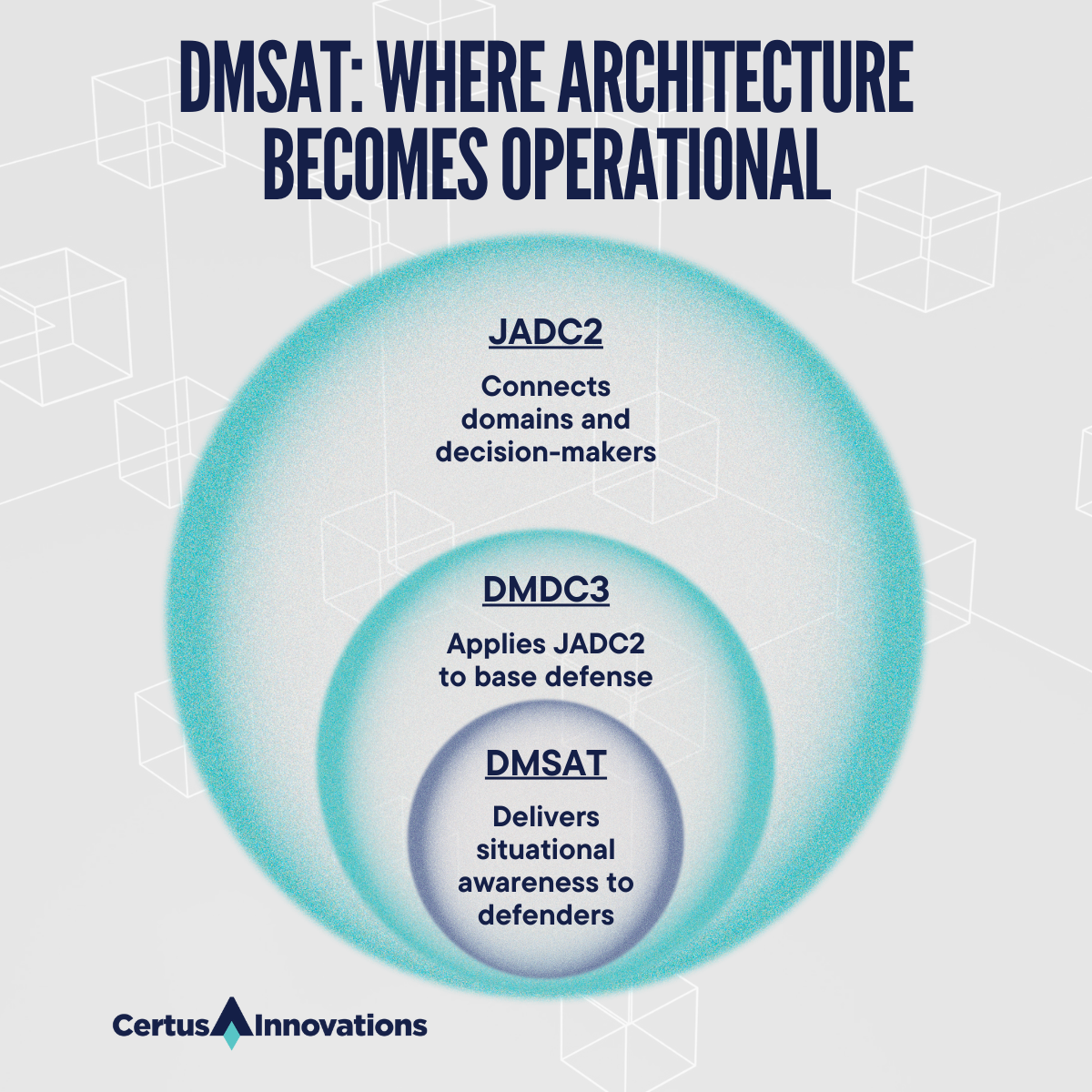
From Architecture to Execution: How DMSAT Supports Enterprise Base Defense
Enterprise architecture is only as strong as its ability to support defenders in real time. According to the Department of Defense, Joint All-Domain Command and Control (JADC2) is intended to “sense, make sense, and act on information across the battlespace quickly” by leveraging automation, AI, and resilient networks, a core modernization priority across DoD.
Programs like Defender Multi-Domain C3 (DMDC3) exist to bring the JADC2 vision into focused, executable capabilities at the base defense level. In an article by Ms. Heidi Scheppers, Deputy Director. Security Forces, HQ AF/A4S, the Deputy Director explains how DMDC3 “integrates computing power (PICARD), the means of communication (DC3), and the tools for situational awareness (DMSAT).” In other words, DMSAT implements JADC2 principles in a concrete, operational way.
On December 17, 2025, Certus Innovations was selected for a DMSAT BPA by the AFLCMC/HBU, allowing the team to support DMDC3 capabilities in a robust way. Certus supports DMSAT delivery within a PMO-managed environment designed to scale force protection capabilities across installations.
DMSAT serves as the mobile situational awareness layer within the DMDC3 ecosystem, enabling Security Forces to visualize force positioning, share information, and coordinate actions at the tactical edge. Rather than remaining a conceptual construct, this approach ensures that enterprise command-and-control principles are applied where timing, clarity, and coordination matter most.
On December 17, 2025, Certus Innovations was selected for a DMSAT Blanket Purchase Agreement by the Air Force Life Cycle Management Center, Force Protection Division (AFLCMC/HBU). This selection enables Certus to support DMSAT delivery within a Program Management Office–managed environment designed to scale force protection capabilities across installations.
For Certus, this work reflects more than a single contract win. It demonstrates the ability to operate inside a Program of Record, meet sustained operational requirements, and deliver mission-ready capability that supports broader defense modernization efforts. This is what readiness looks like when architecture becomes operational, and when enterprise vision is matched by execution in the field.